FREE · ANDROID

Shruti Box and Voice Trainer

The drone of a shruti box in your pocket. Thirteen valves that glow and breathe, 43 drones, ragas and chords, your own presets in a sequencer with crossfade, a voice trainer that listens, and any USB MIDI keyboard to play it all.

Singing over a drone, a small MIDI keyboard plugged into a phone that shows the shruti box The app: three valves glowing, the notes below them
In a nutshell

Everything a drone needs, and a teacher too

◖◗

A living shruti box

Thirteen valves, Sa to Sa'. Tap one and its reed sounds, beating like a real reed, breathing with the bellows.

43

Drones, ragas, chords

8 tanpura tunings, 24 ragas with their aroha and avaroha, 11 chords. Every one moves with your key.

💾

Your own presets

The save icon keeps whatever sounds as a CUSTOM card. Name it, rename it, delete it.

1·2·3

Sequencer with crossfade

Number your cards with taps, press ▶, and they follow each other at your BPM, one fading into the next.

◉

Voice trainer

The box plays a note, you sing it back; a row of lights shows how close you are, to a tenth of a semitone.

AUTO

Guided practice

AUTO walks the scale through any range of the 88 piano keys, at ±20, ±40 or ±60 %.

⌨

Play it with MIDI

Plug in a USB MIDI keyboard: keys held, velocity-sensitive, every key at its own pitch, the screen following your octave.

◀ ▶

Your key, your octave

Sa anywhere from C to B, the box from C1 to B5, a cold blue or a warm amber light, portrait or landscape.

The app

Black ground, light from another world

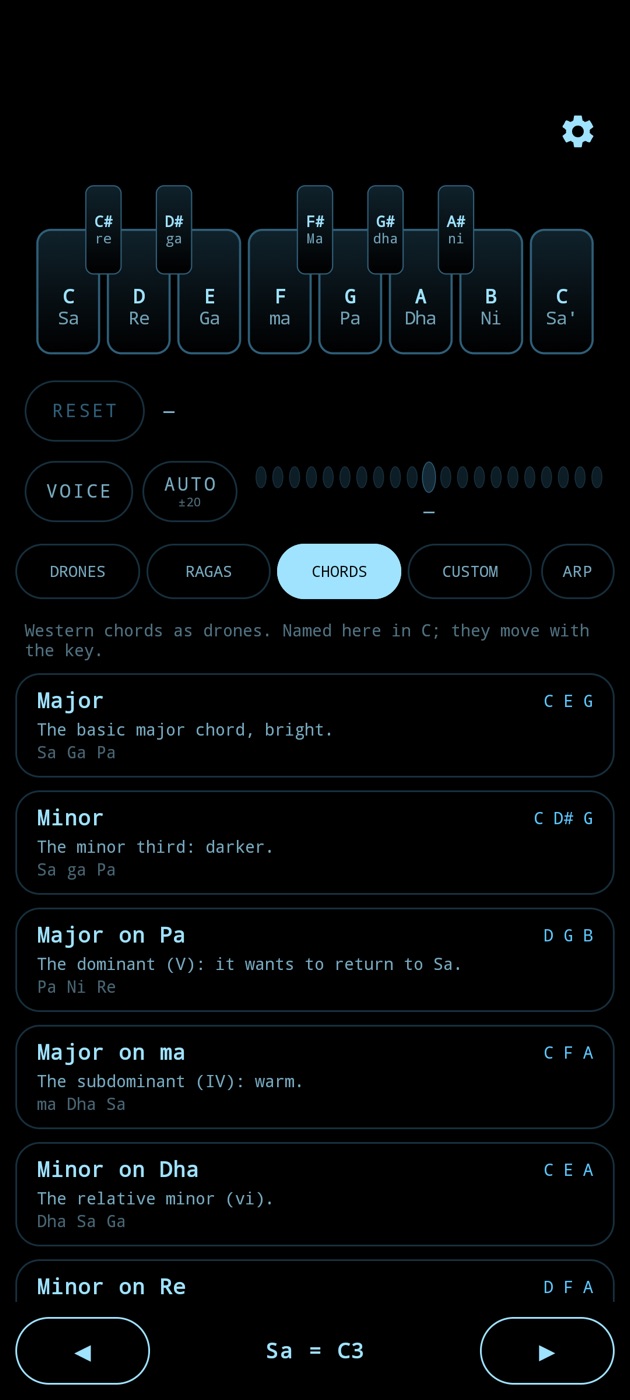
The box at rest
At rest: eight valves of the scale below, five between them above, as on a reed plate.
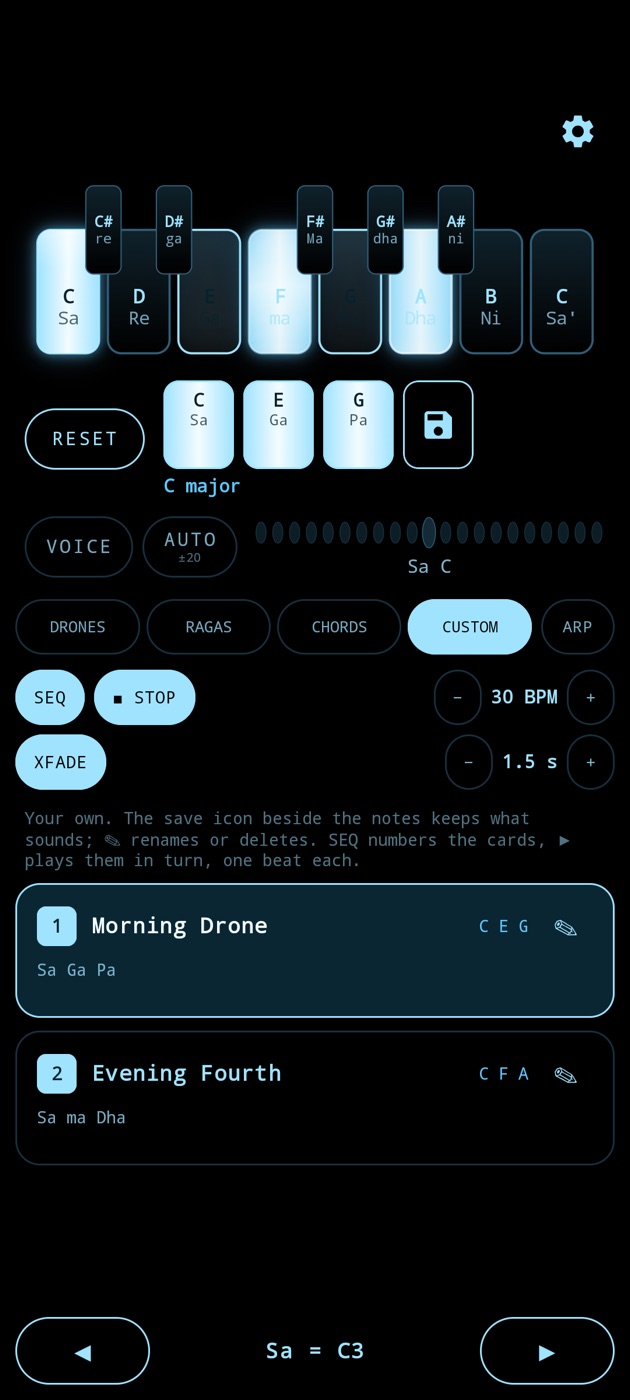
A chord sounding
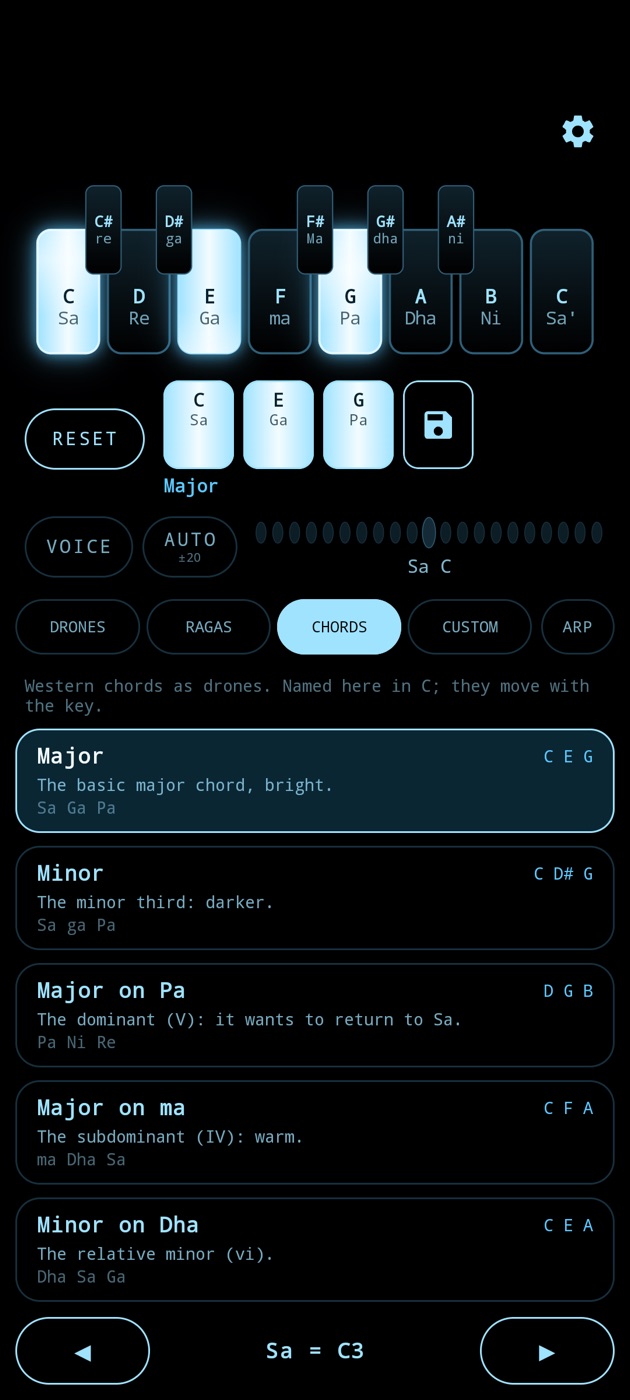
A chord sounds: its valves glow, its notes become buttons, the save icon waits beside them.
The sequencer playing
The sequencer: card 1 plays while the last chord fades out, at 30 BPM, crossfade 1.5 s.
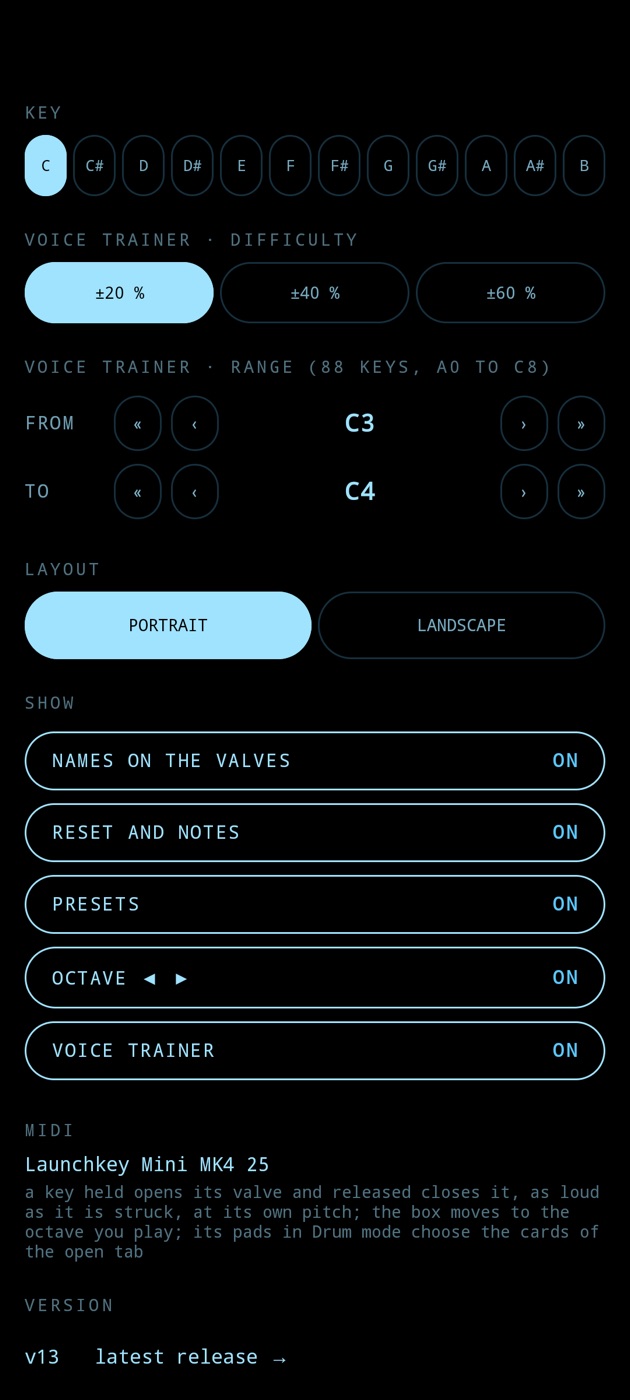
Settings
Settings: key, the trainer's difficulty and range, layout, and the MIDI keyboard it found.
In detail

How it works

The box

Nothing is recorded: every reed is synthesised on the phone. One cycle of a free-reed tone, 28 harmonics with the odd ones stronger, played as two voices a cent and a half apart for the beating of a real reed. Each valve swells in and fades out so a tap never clicks, and the bellows breathe the whole box slowly. Open more valves and the level follows, so the box never shouts.

  • Tap a valve to open it, tap again to close. RESET closes them all.
  • Each sounding note becomes a button: a tap steps it full → half → a line (0, −12, −24 dB).
  • ARP plays any chord as an arpeggio; a raga card's ▶ SCALE plays its aroha and avaroha.

Presets: drones, ragas, chords, custom

DRONES 8RAGAS 24CHORDS 11CUSTOM ∞

The drones keep the tanpura's own logic: Sa, Sa' and one tuning note, Pa as a rule, ma, Ni or Dha when the raga asks for it. The ragas, from Yaman and Bhairav to Malkauns and Charukeshi, carry their thaat, time, mood, aroha and avaroha, and their notes are marked on the valves. The chords are Western chords played as drones.

CUSTOM is yours: whatever sounds, the save icon keeps; ✎ names it.

The sequencer

In CUSTOM, switch on SEQ and tap your cards in the order you want: each gets a number. ▶ SEQUENCE plays them round and round, one beat each, at the BPM you set right there. XFADE lets one chord melt into the next over the time you choose, so the box changes like breath, never like a switch.

The voice trainer

Play a note, close the box, and sing it back. The microphone opens only when every reed is silent, so it hears you and never the shruti. A row of oval lights is the tuner: the middle one is the note, flat to the left, sharp to the right, each light a tenth of a semitone.

  • AUTO starts at once on Sa: the box plays each note of the scale for three seconds, then you sing it; hold it close for two seconds and the next note comes.
  • Difficulty: ±20 % (hardest), ±40 % or ±60 % of a semitone. A long press on AUTO changes it.
  • Range: any stretch of the 88 piano keys, A0 to C8. The box follows each note into its octave.
  • The voice is heard frame by frame and never kept.

Play it with a MIDI keyboard

Any class-compliant USB MIDI keyboard works; it was made with a Novation Launchkey Mini MK4 25. The phone gives it power through the cable.

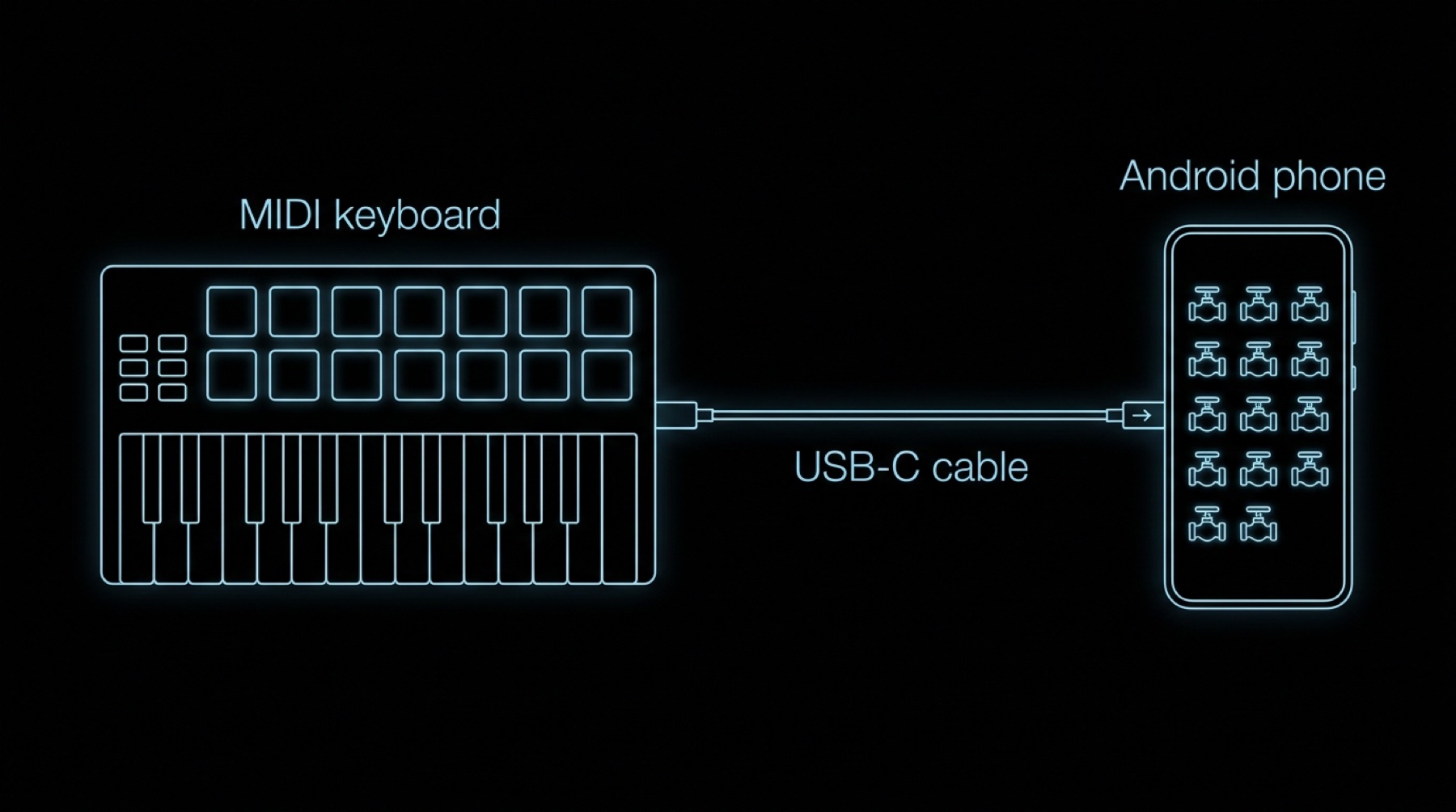
  1. Connect the keyboard to the phone with a USB-C to USB-C cable (or the keyboard's own cable and a USB OTG adapter).
  2. Open the app. Settings → MIDI shows the keyboard's name.
  3. Play. A key held opens its valve, letting go closes it; strike harder and it sounds louder. Play in another octave and the box moves there. In Drum mode, the 16 pads choose the cards of the open tab.

No change in loudness? Your keyboard may be set to a fixed velocity in its own settings.

The keyboard we use: Novation Launchkey Mini 25 MK4, 25 mini keys, 16 pads, small and powered by the phone. About €114 on Amazon.de (October 2026). See it on Amazon.de →

Connection: MIDI keyboard, one USB-C cable, Android phone

Play for hours: charge while you play

The phone has one USB-C port, and the keyboard takes it. To keep the phone charging through a long kirtan or a morning practice, put a small USB-C hub with Power Delivery pass-through between them.

  1. The hub's own cable goes into the phone.
  2. The MIDI keyboard goes into one of the hub's data ports.
  3. Your USB-C charger goes into the hub's PD port: the phone charges and powers the keyboard at the same time.
The hub we use

SATECHI USB-C Hub 4-in-1

Aluminium body and braided cable, four USB-C ports at 10 Gbps, 100 W Power Delivery pass-through. Small enough to live in the keyboard's bag.

about €43 on Amazon.de (October 2026)

See it on Amazon.de →

Any USB-C hub with PD pass-through and USB-C data ports works the same way. Check the price on more than one site before you buy: identical hubs often cost twice as much.

The story

From France to India: how a drone found its box

The free reed, a thin tongue of metal that sings when air passes it, is far older in Asia than in Europe: the Chinese sheng is named in the Shi Jing, three thousand years ago. Europe met it in the late 18th century, and by the 1840s it had become an instrument of its own.

1840 · FRANCE

Alexandre Débain receives a patent for the instrument and for its name, harmonium: free reeds, blown by foot treadles.

MID TO LATE 1800s · BENGAL

The harmonium reaches India through traders and missionaries, first in West Bengal. Indian musicians sit on the floor, so the foot pedals give way to bellows pumped by hand.

1875 · CALCUTTA

Dwarkanath Ghose founds D. Ghosh and Sons (later Dwarkin) on Lower Chitpur Road and is credited with adapting the imported instrument into the hand-pumped Indian harmonium.

THE DRONE GETS ITS OWN BOX

Before, the drone came from the tanpura. Musicians began holding harmonium keys down for a steady Sa and Pa; then a box without keys was built for the drone alone: the shruti box, also called sur peti. A keyless harmonium, only for the drone.

1971 · BANGALORE

G. Raj Narayan, an engineer and flautist, builds an electronic shruti box, and his electronic tanpura follows in 1979. A drone that never needs pumping.

TODAY · EVERYWHERE

From Indian classical practice to Irish song and the kirtan circles of the world, the shruti box holds the ground: Sa, Pa, Sa', and the voice rising over it.

Why mantras love a drone

A mantra is sound before it is meaning. A steady drone gives the voice a home to return to: you hear at once when you drift from Sa, and every syllable settles on the same ground. That is why the shruti box became the companion of mantra singing, kirtan and bhajan, and of the plain Sa–Pa–Sa practice that every Indian singer starts with. Its player can pump with one hand and sing at the same time; this app needs no hands at all.

To sing over the drone

A few mantras

ॐ
Oṃ
The sacred syllable, often heard as a–u–m. Sing it long over Sa.
ॐ भूर्भुवः स्वः । तत्सवितुर्वरेण्यं भर्गो देवस्य धीमहि । धियो यो नः प्रचोदयात् ॥
oṃ bhūr bhuvaḥ svaḥ tat savitur vareṇyaṃ bhargo devasya dhīmahi dhiyo yo naḥ pracodayāt
Gayatri (Rigveda 3.62.10): we meditate on the radiant glory of the divine Savitr; may it inspire our thoughts.
ॐ नमः शिवाय
oṃ namaḥ śivāya
Salutations to Shiva, the auspicious one. From the Shri Rudram of the Yajurveda.
ॐ मणि पद्मे हूँ
oṃ maṇi padme hūṃ
The mantra of Avalokiteśvara, compassion: often rendered "the jewel in the lotus".
लोकाः समस्ताः सुखिनो भवन्तु
lokāḥ samastāḥ sukhino bhavantu
May all beings in all worlds be happy. A closing at pujas, bhajans and yoga classes.
ॐ शान्तिः शान्तिः शान्तिः
oṃ śāntiḥ śāntiḥ śāntiḥ
Om, peace, peace, peace: the closing of the Shanti mantras, said three times.
Listen

Mantras with a shruti box, around the world

Gayatri Mantra, Chant for PeaceSoulSoundSister

Mangala Mantra Chant with Shruti BoxLumira

Kirtan series, Mantras with Shruti Box DroneHarp Musica

Shruti Box demonstration with Gayatri and Maha Mantrachillbobaggins

Chanting practice with shruti box (Saraswati Mantra)Mary Isis & Pathways of Transformation

Gayatri mantra on the shruti boxPrem Adri

Your drone is waiting

Free, for every singer, every chant, every morning practice.

⬇ Download the latest version APK · 1 MB

Android 8 or newer. Free, no account, no ads, nothing collected. Your phone asks once to allow installing from your browser.